
IPO & Raise Capital | Resources
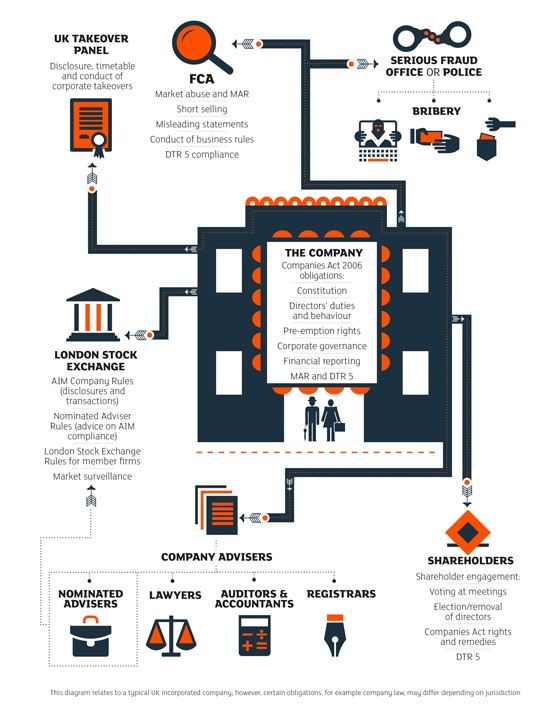
AIM regulatory landscape
AIM regulatory landscape
Note: This infographic is provided in both visual and text formats so that all users can access the information in the way that suits them best.
The company
Companies Act 2006 obligations
- Constitution
- Directors’ duties and behaviour
- Pre-emption rights
- Corporate governance [Note 1]
- Financial reporting
- MAR and DTR 5
UK Takeover Panel
- Disclosure, suitable and conduct of corporate takeovers
FCA
- Market abuse and MAR
- Short selling
- Misleading statements
- Conduct of business rules
- DTR 5 compliance
London Stock Exchange
- AIM Company Rules (disclosures and transactions)
- Nominated Advisers Rules
- London Stock Exchange Rules for member firms
- Market surveillance
Serious fraud office or police
- Bribery
Company advisers
- Nominated advisers
- Lawyers
- Auditors & accountants
- Registrars
Shareholders
- Shareholders engagement
- Voting at meetings
- Election/removal of directors
- Companies Act rights and remedies
- DTR 5
Note
[1] This diagram relates to a typical UK incorporated company; however, certain obligations, for example company law, may differ depending on jurisdiction. | Back to Note 1
London Stock Exchange
London Stock Exchange (Exchange) is a Recognised Investment Exchange (RIE) under the UK’s Financial Services and Markets Act (FSMA).
AIM is operated and regulated by the Exchange in this capacity under Part XVIII of FSMA 2000, and as such AIM is a ‘prescribed market’ under FSMA 2000 which brings it within the market abuse provisions.
The Exchange operates AIM with an overarching objective of maintaining the integrity and reputation of its growth market. The market structure and rules are designed to be relevant to growth companies and their investors. The Exchange undertakes its regulation of AIM through its AIM Regulation and Market Supervision teams. AIM Regulation is responsible for the compliance by AIM companies and Nominated Advisers with the AIM Rules and the Market Supervision team monitors the trading in AIM securities by member firms which are subject to London Stock Exchange’s trading rules.
AIM companies and nominated advisers
The AIM Rules for Companies and AIM Rules for Nominated Advisers form the basis of London Stock Exchange’s regulation of AIM companies and the nominated advisers. The AIM Rules sit within a wider landscape of regulatory and legal duties which are broadly similar to those protections provided to Main Market companies and their investors. Accordingly, the Exchange’s remit in respect of companies admitted to AIM is limited to compliance with its rule books. Actions of companies and directors that relate to wider legal duties and obligations are within the remit of the relevant competent body or regulator. The AIM Regulation team at London Stock Exchange undertakes its regulatory role by reference to the AIM rule books:
The AIM Rules for Companies (PDF) and AIM Rules for Nominated Advisers (PDF) form the basis of the Exchange’s regulation of AIM companies and nominated advisers. The AIM Rules sit within a wider landscape of regulatory and legal duties which are broadly similar to those protections provided to Main Market companies and their investors. Accordingly, the Exchange’s remit in respect of companies admitted to AIM is limited to compliance with its rule books. Actions of companies and directors that relate to wider legal duties and obligations are within the remit of the relevant competent body or regulator. The AIM Regulation team at the Exchange undertakes its regulatory role by reference to the AIM rule books:
- The AIM Rules for Companies which set out the obligations on a company during and on application to AIM, as well as the ongoing obligations that apply to the company whilst it is admitted to AIM.
- The AIM Rules for Nominated Advisers which set out obligations owed to the Exchange in respect of the nominated adviser’s role to consider issues of appropriateness of an AIM Company and to provide ongoing advice and guidance to AIM company clients on their AIM Rules obligations.
- Additional rules apply to investing companies (Investing Company Note) and resource companies (Mining Oil and Gas Note).
The AIM rule books have been designed to ensure that the rules governing companies admitted to AIM are relevant to meet the needs of growing companies and their investors. They sit alongside primary legislation which is the remit of other regulators and law enforcement agencies that also provide protections to investors in respect of AIM in the same way as they do for the Main Market.
The Exchange undertakes a lead role in the regulation of AIM and works closely with other regulators and law enforcement bodies to ensure that the investigation and enforcement of matters relating to AIM companies, their directors or potentially abusive trading in AIM securities are undertaken by the authority that has the most appropriate remit and investigation and enforcement powers.
The activities of the AIM Regulation team within the Exchange include: policy matters and changes to the AIM rule books; authorising and approving firms to act as nominated advisers; providing advice and guidance to nominated advisers on the interpretation of the AIM Rules; and providing oversight of the performance by the nominated advisers of their obligations owed to the Exchange pursuant to the AIM rules.
Furthermore, the AIM Regulation team undertakes investigations and considers disciplinary or other action, as appropriate to the circumstances, in respect of potential breaches of the AIM rule books by AIM companies and/or nominated advisers. AIM Regulation has a variety of private and public sanctions it can utilise in respect of the enforcement of its rules. All public censures are published and the Exchange may also publish private censures (anonymising the relevant company/nominated adviser) for the purpose of educating the market in circumstances where the nature of the breach is not sufficient to warrant a public censure or is unlikely to reoccur. This range of sanctions enables the Exchange to apply the most appropriate sanction taking into account all the circumstances and ensuring that it achieves its objectives of providing education to the market; ensuring change in future behaviour; and deterring future breaches.
Trading of AIM securities on London Stock Exchange
The Market Supervision team at the Exchange monitors the trading in AIM securities that is undertaken on the Exchange by member firms to ensure trading is orderly, efficient and in compliance with the London Stock Exchange’s trading rules. It also refers to the FCA potential cases of market abuse that it may identify.
The Exchange’s AIM Regulation and Market Supervision teams work closely with and liaise on relevant market issues including ensuring that real time issues of disclosure are addressed by AIM companies on a timely basis and in accordance with the AIM Rules.
The suspension of AIM securities from trading is part of the Exchange’s real-time operation of AIM to maintain an orderly market, including where a company has not been able to make appropriate disclosure promptly. If a company is not able to comply with the AIM Rules for a prolonged period its admission may be cancelled.
Company advisers
Nominated advisers
A key feature of AIM is the nominated adviser role. Nominated advisers are firms that provide corporate finance advice with particular expertise on AIM and are approved by the Exchange to act for companies that have, or wish to have, their securities admitted to trading on AIM. They will advise and guide the company on its ongoing obligations under the Exchange’s AIM rule books. A company admitted to AIM is required to have a nominated adviser at all times whilst it has securities admitted to trading.
It is the nominated adviser who will assess whether a company is appropriate for AIM, having considered all relevant matters set out in the AIM Rules. The nominated adviser will also advise on the compliance of the company’s Admission Document with the relevant rules. The nominated adviser makes a declaration to the Exchange in relation to this. The nominated adviser is also required to understand the business of the company so that it is well placed to provide ongoing support to the company in respect of its compliance with the AIM Rules, for example, in relation to matters such as ongoing disclosure. Whilst this support is important for AIM companies given their size and nature, it should be noted that the obligation for compliance with the AIM Rules for Companies remains at all times with the AIM company.
The AIM Rules for Nominated Advisers set out obligations owed by nominated advisers solely to the Exchange. These rules do not deal with the services that a nominated adviser may provide directly to its clients, for example, through its contract with an AIM company. Any such services between the nominated adviser and the AIM company will normally be set out in a private agreement. It is likely that a nominated adviser firm might undertake other roles for a client company, e.g. sales or broking. Whilst these are not regulated by the Exchange, the AIM Rules for Nominated Advisers contain provisions governing independence and conflicts of interest.
Lawyers
Lawyers will be involved in the admission of a company to AIM, including performing legal due diligence on the business and advising and guiding both the company and the nominated adviser on the legal aspects of the admission process. As with any company or business, AIM companies may choose to engage lawyers to advise them on an on-going basis in relation to various discrete matters including commercial contracts, acquisitions, corporate activity and compliance with legislation. However, an AIM company’s nominated adviser remains the company’s principal adviser in relation to its compliance with the AIM Rules.
Accountants and auditors
A firm of accountants, as reporting accountants, will be required to perform financial due diligence on a company as part of its proposed admission to AIM.
Furthermore, a company will have filing obligations under its Companies Act obligations as well as under the AIM Rules which require the company to publish an annual report and audited accounts for each financial year within 6 months of the year end and to notify a half-yearly report within three months of the period end. Therefore, every company must engage an auditor to audit its annual accounts. The UK’s Financial Reporting Council (“FRC”) provides independent oversight over public company accounts and the regulation of auditors. Recognised professional accounting bodies also provide oversight of firms providing accountancy, auditing and insolvency services. In addition, an AIM company may also engage accountants to assist it in relation to ongoing financial reporting or in relation to discrete matters, such as tax matters, on an ad-hoc or regular basis.
For further details of and how to contact the FRC, please visit Financial Reporting Council.
Registrars
All companies will need to maintain a share register and this function is often outsourced by publicly traded companies, including AIM companies, to a professional registrar. The primary role of the registrar is to maintain the company’s share register and ensure that it is up to date. The registrar may also provide additional services including company secretarial services and/or facilitate formal regulatory communications with shareholders (e.g. notices of general meetings etc.).
The Financial Conduct Authority (FCA)
As the leading financial services regulator in the UK, the objectives of the FCA , as set out in FSMA (as amended by the Financial Services Act 2012) and the Financial Services and Markets Act 2023) are to: Protect consumers, to secure an appropriate degree of protection for consumers; Protect financial markets, to protect and enhance the integrity of the UK financial system; to Promote competition, to promote effective competition in the interests of consumers; and Promote competitiveness and growth, to facilitate the international competitiveness and medium-to-long-term growth of the UK. The FCA regulates the Exchange, as an RIE. From an AIM company perspective, it has powers to investigate disclosures made by an AIM company where they may be false or misleading statements and which (intentionally or recklessly) induce investors to trade or refrain from trading in the company's securities. The FCA is also the competent authority in respect of investigating compliance with the provisions of MAR, such as MAR disclosure obligations and rules regarding PDMRs/PCA’s and inside information and compliance with the relevant aspects of the FCA’s Disclosure and Transparency Rules which apply to UK companies on AIM (i.e. vote holder and issuer notification rules under DTR 5).
From a secondary market perspective (i.e. in respect of the trading of shares in the secondary market), the FCA has both civil and criminal powers available to it to identify and prevent market abuse and will also work with other law enforcement agencies in combatting this. Furthermore, given the FCA’s responsibility for the conduct of retail and wholesale financial services firms in relation to consumers, the manner in which these firms are expected to conduct business when communicating with clients is primarily set out in the FCA’s Conduct of Business sourcebook.
For more information, refer to About the FCA.
The Takeover Panel (the “Panel”)
The Panel is an independent body in the UK whose main functions are to issue and administer the City Code on Takeovers and Mergers (the "Code") and to supervise and regulate takeovers and other matters to which the Code applies. Its central objective is to ensure fair treatment for all shareholders in takeover bids.
The Code applies to all companies admitted to trading on AIM which are incorporated in the UK, the Channel Islands and the Isle of Man.
Serious Fraud Office (“SFO”) or Police
The SFO is a government department and is part of the UK criminal justice system. Its role is to investigate and prosecute serious and complex fraud and bribery and corruption For example, the SFO can investigate o investment related frauds depending on the seriousness and complexity of the circumstances. Other relevant law enforcement agencies may also have an interest in and take action where fraud or other economic crime is suspected. Referrals in relation to such matters can be submitted via: Report Fraud
For more information, refer to SFO and Report Fraud.
Company Investigation unit at Department for Business, Energy and Industrial Strategy (“BEIS”)
The company investigation unit at BEIS may have remit to consider misconduct by companies or individual directors. Further details are available at: Live company investigations - what we do - GOV.UK; and Investigations and enforcement: what we do, our outcomes and complaints - GOV.UK
Shareholders
AIM is a buyer beware market and as such investors are responsible for considering whether the risk profile of the companies and the AIM market model is within their investment risk appetite and must take full responsibility for their investment decisions.
In making those investment decisions, investors must recognise and accept that there are inherent investment risks associated with AIM companies, which include founder-led, innovative and growing businesses across a diverse range of sectors. Further, investors should take responsibility to consider the source of information which they take into account when making their investment decisions noting that AIM companies have a number of regulatory and legal obligations and potential liabilities with regard to the accuracy of the information which is notified via a Regulatory Information Service and accordingly, this is the authoritative source of information.
The Exchange does not owe any duty or have any liability to any investor in respect of any investment decision made in relation to AIM securities. Investors making investment in AIM securities should not place any reliance on the Exchange having admitted a company to AIM as a basis for considering that the Exchange is recommending a company as suitable for investment. The Exchange is not responsible for reviewing, analysing or approving information made available by an AIM company.
A company’s shareholders play a vital role in holding a company and its directors to account by virtue of rights enshrined in company law including the ability to vote on resolutions put to shareholders at general meetings which will include the election and removal of directors, pre-emption rights and the right to requisition a general meeting (subject to a sufficient proportion of shareholders supporting such an action).
Shareholders also have their own obligations under the Disclosure and Transparency Rules to report their shareholding to the company to enable the company to meet its own notification obligations in respect of its significant shareholders. Oversight of compliance of these obligations of shareholder disclosure is the remit of the FCA.
Certain legal remedies against a company may also be available to shareholders under company law in circumstances where the directors have acted outside of their powers.
The Company
An AIM company will be subject to a range of regulatory and legal obligations which it must comply with. Its AIM Rules obligations are just one aspect of this. The primary obligations owed by a company are set out under company law. A company will have in place articles of association which set out the constitution of the company, including the core duties and obligations of its shareholders and directors.
In respect of a company’s obligations under the AIM Rules, the responsibility for compliance rests with the company itself and it must have in place appropriate systems, procedures, resources and controls to ensure compliance, seeking advice from its nominated adviser whenever appropriate and taking that advice into account in meeting its obligations.
Contacting AIM Regulation
Market participants
AIM Regulation considers enquiries and complaints regarding the conduct of AIM companies and nominated advisers in respect of their compliance with the AIM Rules for Companies (PDF) and for Nominated Advisers (PDF).
If you have an enquiry or complaint relating to an AIM company or a nominated adviser's compliance with the AIM Rules for Companies and for Nominated Advisers, please provide details to aimregulation@lseg.com, or by post to: AIM Regulation, London Stock Exchange, 10 Paternoster Square, London, EC4M 7LS.
Further information regarding the Exchange’s complaints processes can be found on Complaints Process and Guidance and in the AIM Market FAQs & Answers.
Nominated advisers
AIM Regulation provides an email enquiry and telephone service for nominated advisers, as they are the primary regulators of AIM companies. In very exceptional circumstances where an AIM company does not have a current nominated adviser appointed, AIM Regulation is able to deal with queries from an AIM company’s other advisers, such as lawyers and accountants, or from the company itself.
- The AIM Rules for Nominated Advisers state that AIM Regulation will not provide guidance to nominated advisers on a ‘no-names’ basis in relation to detailed or specific regulatory matters. The relevant company’s name and the enquirer’s details should be disclosed to AIM Regulation so it can provide appropriate advice. All information received is kept confidential, in accordance with the AIM Rules for Companies and for Nominated Advisers. If AIM Regulation does provide any guidance on a ‘no-names’ basis, it is provided for general, high-level purposes only and it is non-binding upon the Exchange and should not be relied upon.
- Before contacting AIM Regulation, please ensure you have first checked all appropriate resources. Contacting AIM Regulation should not be treated as a substitute for the nominated adviser reviewing these in the first instance.
- Complex or specific queries, class test queries or requests for rule derogations must be sent by email by a company's nominated adviser.
- When contacting AIM Regulation, you must provide it with all the material information necessary for it to advise on the query. If AIM Regulation provides advice or a derogation and the information on which this was based subsequently changes, you should approach AIM Regulation again as soon as possible.
- AIM Regulation strives to respond to all queries as quickly as possible. However, complex or policy-related queries may require three business days or possibly longer if the team needs to access further information. This timescale should be factored into any transaction timetable. In any event, AIM Regulation should always be contacted at the earliest opportunity.
- A nominated adviser should not assume that a derogation from the AIM Rules has been provided unless a member of the AIM Regulation team has confirmed this expressly in writing (i.e. via an email) to the company’s nominated adviser.
- Please note that all telephone calls to and from AIM Regulation are recorded to enable the Exchange to carry out its regulatory responsibilities. Please see London Stock Exchange's privacy statement for further details.
You can contact AIM Regulation preferably by email on aimregulation@lseg.com or alternatively on +44 (0) 20 7797 4154.
If your query relates to a secondary markets matter only, please contact the Exchange’s Market Supervision team on +44 (0) 20 7797 3666 (STX 33666).
